CBD oil under the tongue: do the 60 seconds matter?
The usual advice is to hold CBD oil drops under your tongue for 60 to 90 seconds before swallowing. No study has validated that time. The only trial in humans that compared the same oil as sublingual drops and as capsules measured equivalent blood levels, peaking after 4 hours in both cases. What clearly changes how much CBD is absorbed is food.
Contents
> Key takeaways > > - In a trial published in 2024, eight men took the same oil as sublingual drops or as capsules: no difference in blood CBD. > - The authors conclude that the oil is swallowed before the lining of the mouth can absorb it. > - A high-fat meal raised CBD exposure 4.2-fold in a 2018 trial. > - One drop of a 10% oil contains about 4 to 5 mg of CBD, depending on the dropper. > - Since 2026, CBD oil can no longer be sold in France as a food or food supplement.
What trials measured under the tongue
The sublingual route means placing a product under the tongue so that it crosses the thin, blood-rich lining of the mouth and goes straight into the bloodstream. Applied to CBD, the idea is appealing: part of it would bypass the liver, which breaks a lot of it down on a first pass after swallowing. It still has to be measured.
A team at Loughborough University did just that. Eight men received, in random order, the same hemp oil at 69 mg of CBD per mL, either as drops under the tongue or in capsules, with a placebo to hide the form. The result, published in Cannabis and Cannabinoid Research: plasma CBD concentrations did not differ between drops and capsules. The peak came after 4 hours in both cases, and the area under the curve over 6 hours, which reflects the total amount of CBD that reached the blood, was 41.8 versus 45.3 ng/mL·h. For the authors, oil placed under the tongue is swallowed before the lining can absorb it.
A second trial points the same way. In 12 volunteers, a sublingual CBD wafer and an oil solution gave comparable relative bioavailability, with a blood peak around 4 hours. A peak at 4 hours is not the profile of fast absorption through the mouth.
These groups are small, and neither trial tested holding times. They do not prove the sublingual route is useless. They show that with an ordinary oil, the expected advantage does not show up in the blood.
Why the oil mostly ends up swallowed
CBD is fat-soluble: it dissolves in fats, not in water. In an oil, it stays in the carrier liquid, which mixes poorly with saliva and slides towards the throat. The area under the tongue also offers only a small contact surface.
Once swallowed, CBD goes through the gut and then the liver, where part of it is transformed before reaching the circulation. How much? Nobody knows precisely. The reference systematic review on CBD pharmacokinetics notes that no study has measured the absolute oral bioavailability of CBD in humans. The precise percentages circulating online are therefore not based on a direct human measurement.
So-called water-soluble or nanoemulsion formulations try to get around exactly this problem. Our article on water-soluble CBD looks at what they change and at their legal status.
Food matters more than where the drops go
Because CBD dissolves in fats, what is in your stomach counts. In a phase I trial published in 2018, 12 volunteers took 1,500 mg of CBD fasting, then after a high-fat meal. The meal raised CBD exposure 4.2-fold and the blood peak 4.85-fold, without changing the time to peak.
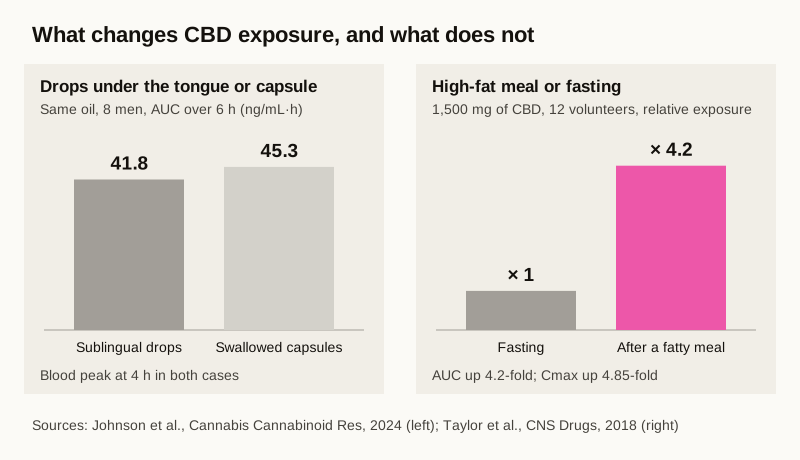
The same effect shows up at low doses. The 2018 review reports that, for a mouth spray delivering 10 mg of CBD, the area under the curve and the peak were about five and three times higher after a meal than fasting. The gap between two doses depends far more on what is on your plate than on the seconds spent under the tongue.
This gap has a practical consequence: the same amount can give very different blood levels depending on the time of day. It is also why the time people feel it takes varies so much from one person to the next, as our article on how long CBD takes to work explains.
How much CBD is in a drop: the maths
The percentage on a bottle usually reads as a mass of CBD per 100 mL of oil. A 10% oil therefore provides about 100 mg of CBD per millilitre. The size of a drop depends on the dropper and the oil: count how many drops it takes to fill 1 mL with your dropper, then divide.
| Concentration | CBD per mL | Per drop, if 1 mL = 20 drops | Per drop, if 1 mL = 25 drops |
|---|---|---|---|
| 5% | 50 mg | 2.5 mg | 2 mg |
| 10% | 100 mg | 5 mg | 4 mg |
| 20% | 200 mg | 10 mg | 8 mg |
The figure that matters is the one measured on the batch, not the one in the product name. On the pages of our CBD oils checked on 23 September 2026, the batches shown measure 5.1 to 19.6% CBD. Our guide to reading a certificate of analysis shows where to find that number.
Set this calculation against an official benchmark. On 9 February 2026, EFSA published a provisional safe intake level of 0.0275 mg per kilo per day, about 2 mg a day for a 70 kg adult. It applies to CBD at least 98% pure, in a food supplement. It excludes people under 25, pregnant or breastfeeding women and anyone on medication. It is not an authorisation. A single drop of a 10% oil already exceeds it. Our article on EFSA's reference dose walks through the calculation.
What French rules say in 2026
Taking CBD by mouth now runs into food law. On 20 May 2026, the French agriculture ministry restated that foods containing CBD are not authorised under the EU novel food regulation, food supplements included, and announced controls across the board. A CBD oil presented as a food or supplement can therefore no longer be sold. Our article on CBD regulation in 2026 describes what remains on sale.
This page reports what research has measured about CBD absorption. It replaces neither the product label nor medical advice. CBD acts on liver enzymes that break down many medicines: if you take any treatment, read our article on CBD and drug interactions and talk to your doctor or pharmacist.
Frequently asked questions
Should you hold CBD oil under your tongue before swallowing?
No study has shown that the time matters. In the trial published in 2024, sublingual drops and capsules of the same oil gave the same blood levels, with a peak at 4 hours. The 60 to 90 seconds rule comes from habit, not from a measurement.
Does the sublingual route work faster than capsules?
The two available trials do not show it. With an oil or a sublingual wafer, blood CBD peaked at around 4 hours, just as with a swallowed dose.
Should you take CBD with a meal?
A high-fat meal raised CBD exposure 4.2-fold in a 2018 trial. Food therefore changes the amount absorbed a great deal: it is the variable to keep constant if you compare two doses.
How many mg of CBD are in a drop?
It depends on the concentration and the dropper. A 10% oil contains about 100 mg of CBD per mL; if your dropper gives 20 drops per mL, one drop carries 5 mg, and 4 mg if it gives 25.
Written by the Phytogrammes team
Every article in this journal draws on primary sources (ANSM, EFSA, EUR-Lex, peer-reviewed publications) and on the lab's own practice: batch-by-batch HPLC analyses, measured cannabinoid profiles. Our approach.
Article published on . CBD is not a medicine.