NORML: what it stands for and what NORML France does
NORML stands for National Organization for the Reform of Marijuana Laws. Founded in Washington in 1970, it campaigns for the legalisation of adult cannabis use in the United States. NORML France is a French non-profit association, affiliated but autonomous, that argues for regulating cannabis: it sells no products, and its work does not change the legal status of CBD.
Contents
> Key takeaways > > - NORML was born in November 1970 in Washington, around the lawyer Keith Stroup. > - NORML France was registered with the prefecture on 6 January 2014, after three associations merged. > - Its motto: "Regulate cannabis to reduce risks better". > - It fought the rise of France's fixed fine for drug use from €200 to €500, in force since 20 August 2026. > - CBD with no more than 0.30% Δ⁹-THC is already legal: NORML's advocacy concerns THC-rich cannabis.
What does NORML stand for? The acronym and its American origin
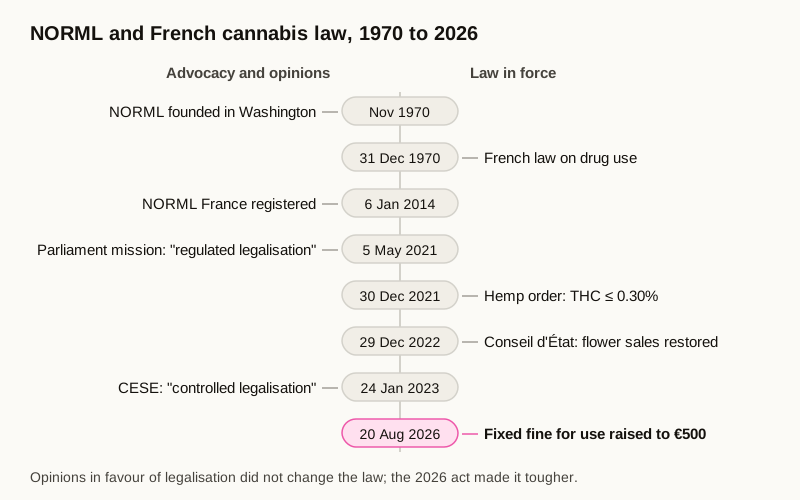
The acronym reads National Organization for the Reform of Marijuana Laws. According to the organisation's own account, the lawyer R. Keith Stroup and a few friends met in early November 1970 in a row house in Georgetown, Washington. They considered laws punishing adult cannabis use counter-productive. The organisation was recognised as a non-profit on 2 March 1971.
Its mission, as it puts it today: shift public opinion far enough to legalise responsible adult use, and advocate for consumers. NORML is a lobby that works directly with lawmakers. In the United States it relies on a network of local chapters, and its name has been taken up abroad, including in France.
The date has an echo in France. The law of 31 December 1970, passed the same year, laid the foundations for punishing drug use. Its provisions now sit in the Public Health Code. Our article on French cannabis law traces how it has changed.
NORML France: a non-profit association, affiliated but autonomous
The statutes of NORML France describe a non-profit association governed by the French law of 1901. It grew out of a merger of three groups: CIRC Nord-Est, set up in 1997, Chanvre & Violettes, set up in 2011, and an earlier NORML France, set up in 2013. After two interim names, Chanvre & Libertés and then CL-NORML France, it was registered with the Haute-Garonne prefecture on 6 January 2014. Its current statutes were adopted by online vote on 1 October 2023.
The statutes set four missions:
- promote scientific research on cannabis;
- inform the public;
- help users access healthcare and their rights;
- bring civil society together around a reform based on scientific evidence and human rights.
The association states that it is linked to NORML in the United States, but autonomous in its action, leadership and funding. Its planned resources are membership fees, donations, income from activities, sponsorship and possible public grants. It does not sell cannabis or CBD: it is a player in public debate, not a business.
What the association stands for, and what the law did
The motto on the NORML France website sums up the line: "Regulate cannabis to reduce risks better". In practice, the association publishes analyses, takes positions during parliamentary debates and supports access to medical cannabis, which our article on medical cannabis in France follows.
Several public bodies have issued opinions close to that line. None of them changed the law.
| Body | Date | Position | Effect on the law |
|---|---|---|---|
| National Assembly fact-finding mission | 5 May 2021 | "Regulated legalisation" of cannabis | No law passed |
| Economic, Social and Environmental Council (CESE) | 24 January 2023 | "Controlled legalisation", adopted by 87 votes to 25 | Advisory opinion |
| Parliament, law no. 2026-798 | 18 August 2026 | Fixed fine for use raised to €500 | In force |
In April 2021, NORML France sent a paper with 22 recommendations to the parliamentary fact-finding mission on cannabis. The mission's interim report, presented on 5 May 2021, concluded that the repressive policy had failed and proposed "regulated legalisation", after a public consultation that drew more than 250,000 contributions. On 24 January 2023, the Economic, Social and Environmental Council adopted an opinion in favour of controlled legalisation, by 87 votes to 25 with 16 abstentions.
The law went the other way. Since 20 August 2026, article L3421-1 of the Public Health Code, amended by law no. 2026-798 of 18 August 2026, sets the fixed fine for drug use at €500, €400 if paid quickly and €1,000 if increased. The offence is still punishable by one year in prison and a €3,750 fine. NORML France opposed it: its review of the debates, published on 13 July 2026, echoes the analysis of the Collectif pour une nouvelle politique des drogues, for which the fixed fine is "a demagogic measure" that makes the ability to pay a criterion of punishment.
CBD and cannabis: two separate legal debates
NORML's advocacy targets THC-rich cannabis, which is classified as a narcotic. CBD falls under a different, settled framework. The order of 30 December 2021 authorises hemp varieties with no more than 0.30% Δ⁹-THC, and caps extracts at the same level. The Conseil d'État ruling of 29 December 2022 struck down the ban on selling raw flowers and leaves. Our article on the legal THC level explains that threshold.
The two topics meet at three points that matter to a CBD buyer:
- A product outside the order's conditions becomes a narcotic again. MILDECA, which coordinates French drug policy, says so plainly: above 0.30% THC, or with a classified molecule such as HHC, drug enforcement applies.
- Behind the wheel, a trace is enough. The same page notes that simply finding THC in a driver's body establishes the offence, including after a CBD product. Our article on CBD and driving sets out the penalties.
- Campaign pages age. A NORML France page on CBD sales, published in July 2021 and still online, cites a 0.2% THC threshold that predates the December 2021 order. For the law in force, rely on the official texts.
So a CBD user does not need to follow the legalisation debate to buy a compliant product. It does help to understand the boundary, which our article on whether CBD is a drug explains, and to compare it with other countries' choices in our overview of legal models around the world.
Frequently asked questions
What does NORML stand for?
NORML is short for National Organization for the Reform of Marijuana Laws. The organisation was founded in November 1970 in Washington.
Does NORML France sell CBD or cannabis?
No. It is a French non-profit association. It informs the public, publishes analyses and takes part in public debate; it sells no products.
Is NORML France part of NORML in the United States?
It says it is linked to NORML, but its statutes describe it as autonomous in its action, leadership and funding. It was registered with a French prefecture on 6 January 2014.
Will cannabis be legalised in France?
No such law has been passed. A parliamentary mission in 2021 and the CESE in 2023 proposed controlled legalisation, but the law of 18 August 2026 instead raised the fixed fine for drug use to €500.
Does the €500 fine apply to CBD?
Not to a compliant product: made from authorised hemp, with no more than 0.30% Δ⁹-THC and no classified molecule. A product above that threshold, or containing HHC, H4CBD or THCP, counts as a narcotic.
Written by the Phytogrammes team
Every article in this journal draws on primary sources (ANSM, EFSA, EUR-Lex, peer-reviewed publications) and on the lab's own practice: batch-by-batch HPLC analyses, measured cannabinoid profiles. Our approach.
Article published on . CBD is not a medicine.