Switching from THC to CBD: withdrawal, saliva tests, the law
Switching from THC to CBD means leaving a psychoactive molecule classed as a narcotic for one that is not: CBD does not reproduce the effect of THC and is not a treatment for withdrawal. Among regular users, stopping THC often brings symptoms, which peak between day 2 and day 6. Three practical points remain: residual THC in products, roadside saliva tests and the free support available.
Contents
- 01THC and CBD: two molecules, two legal statuses
- 02THC withdrawal: how common, and when
- 03Does CBD help you quit? What research has measured
- 04Choosing a product: format and residual THC
- 05Testing and driving: the trap of traces
- 06False substitutes: HHC, H4CBD, THCP
- 07Getting support: three free options
- 08Frequently asked questions
> Key takeaways > > - A 2020 meta-analysis found withdrawal symptoms in 47% of regular or dependent users. > - Symptoms start on days 1 to 3, peak on days 2 to 6 and usually last up to 3 weeks. > - Trials of CBD for quitting cannabis are still experimental, according to a 2025 Cochrane review. > - A full-spectrum CBD product can contain up to 0.30% THC, enough for a positive saliva test. > - In France, Drogues Info Service answers on 0 800 23 13 13, free and anonymous, from 8 am to 2 am.
THC and CBD: two molecules, two legal statuses
THC (Δ⁹-tetrahydrocannabinol) produces the psychoactive effect of cannabis. CBD (cannabidiol) comes from the same plant but does not. In France, THC is a narcotic; CBD can be sold freely if the finished product contains no more than 0.30% Δ⁹-THC, the limit set by the order of 30 December 2021. The Conseil d'État struck down on 29 December 2022 the ban on selling raw flowers and leaves that the order contained.
| THC | CBD | |
|---|---|---|
| Psychoactive effect | Yes | No |
| Status in France | Narcotic | Free sale if Δ⁹-THC ≤ 0.30% |
| Targeted by saliva tests | Yes | No |
The consequence is simple: CBD is not "light THC". Anyone expecting the same high will be disappointed. Anyone who wants to keep a ritual, a flower, a smell, a gesture, without the psychoactive molecule may find what they are looking for. Our article on the differences between THC and CBD covers the chemistry of both molecules.
THC withdrawal: how common, and when
Cannabis withdrawal syndrome is recognised by the American classification of mental disorders (DSM-5): it is diagnosed when at least three symptoms appear within a week of stopping abruptly. The most common are irritability, anxiety, sleep problems, reduced appetite and restlessness.
It is common. A meta-analysis published in 2020 in JAMA Network Open, pooling 47 studies and 23,518 people, found it in 47% of regular or dependent users. The share varies with the setting: 17% in the general population, 54% among outpatients, 87% among inpatients.
Its timeline is well described. In a 2003 study that followed 18 users through 45 days of abstinence, symptoms began between day 1 and day 3, peaked between day 2 and day 6, and most lasted 4 to 14 days. A 2017 review puts the usual duration of the syndrome at 3 weeks at most.
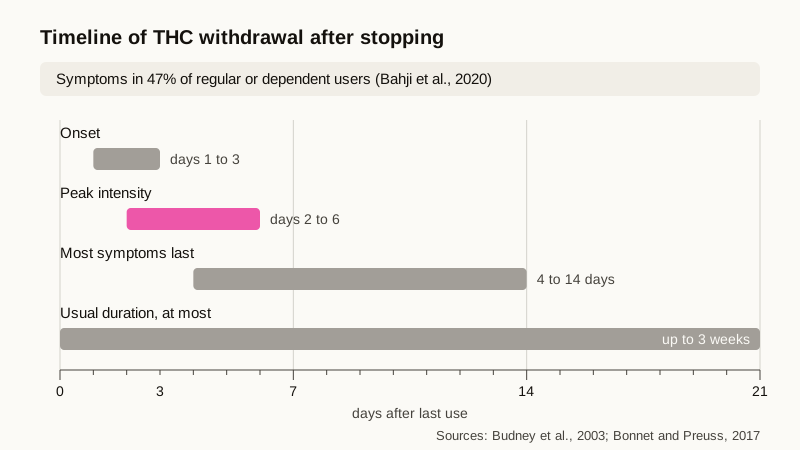
Knowing that the peak falls at the end of the first week helps you not read those difficult days as a failure.
Does CBD help you quit? What research has measured
The question has been studied, and the honest answer is: not demonstrated yet. A phase 2a trial published in 2020 in The Lancet Psychiatry followed 82 adults for 4 weeks, on 400 or 800 mg of CBD a day or a placebo, alongside motivational support. With 400 mg, the authors measured less THC metabolite in urine than on placebo and half an extra cannabis-free day per week (0.48 day). With 800 mg, the gain in abstinent days was not clear.
A Cochrane review published in 2025, covering 37 trials and 3,201 participants, concludes that no medicine is approved for cannabis use disorder and that these options remain experimental. For CBD, it includes a single study of 68 people, with low-certainty evidence. An Australian phase 3 trial of 250 adults is under way.
Two points to add. The doses in these trials, 400 to 800 mg a day, bear no relation to those of products sold in shops. And the only CBD medicine available in France, Epidyolex, is prescribed for certain rare epilepsies, not for withdrawal. CBD is not a treatment for dependence: if quitting alone is hard, support remains the way forward.
Choosing a product: format and residual THC
If you switch to CBD, the choice of format is mostly about habit. A CBD flower keeps the gesture and the smell; a CBD oil removes combustion and is measured with a dropper. Neither is "better" for giving up THC: no data allows anyone to say so.
What matters is residual THC. The 0.30% limit allows traces: a full-spectrum flower or oil can contain some. For someone who wants to leave THC behind or who drives, an isolate or a broad-spectrum product, with no detectable THC on the lot analysis, makes more sense. Our comparison of full spectrum versus isolate and the guide to THC-free oils explain the differences.
On amounts, on 9 February 2026 EFSA set a provisional safe intake level of about 2 mg of CBD a day for a 70 kg adult, in food supplements. The agency does not give a level for people under 25, pregnant or breastfeeding women, or people on medication. The background is in our article on how much CBD per day.
Testing and driving: the trap of traces
Police saliva tests look for Δ⁹-THC, not CBD. Drogues Info Service sums it up: CBD without THC does not make a saliva test positive, and positive results after CBD come from the THC it contains.
Two durations are worth knowing. After a single session of smoked cannabis, a 2014 controlled study measured a median saliva positivity of 12 hours in occasional users (from 4 to 24 hours) and 21 hours in frequent users. In urine, the THC metabolite stays detectable much longer: among 86 chronic users, a 1985 study recorded 27 days on average, and up to 46 days. Switching to CBD therefore does not reset a urine test.
French law does not look at the dose. The Cour de cassation ruled on 21 June 2023 that driving after using narcotics is an offence whatever the amount taken, and that the product's compliance with the 0.30% limit makes no difference. Article L235-1 of the Highway Code punishes this offence with 3 years in prison and a €9,000 fine. The CBD and drug testing guide covers the three types of test, and the article on clearing THC from the body takes apart the methods said to speed it up.
False substitutes: HHC, H4CBD, THCP
Some products sold as "legal alternatives" to cannabis contain semi-synthetic molecules that mimic THC. They are classed as narcotics. ANSM banned HHC, HHCO and HHCP from 13 June 2023, then H4CBD, THCP and other derivatives from 3 June 2024.
For anyone trying to leave THC behind, these products are a dead end: they reproduce the effect you are moving away from, with narcotic status and an often unknown composition. Our timeline of the HHC ban and the article on synthetic cannabinoids explain how to spot them.
Getting support: three free options
Quitting THC does not have to be done alone, and help exists at no cost in France.
- Drogues Info Service answers on 0 800 23 13 13, from 8 am to 2 am, 7 days a week. The call is anonymous and free.
- Consultations jeunes consommateurs (CJC) offer free, confidential appointments, mainly for 12 to 25-year-olds, and also see parents.
- Your GP can assess dependence and refer you, if needed, to an addiction clinic.
Frequently asked questions
Can CBD help you stop THC?
It has not been shown. A 2020 trial of 82 adults measured lower use with 400 mg a day, but a 2025 Cochrane review considers these options experimental. CBD is not a treatment for dependence; support remains the recommended route.
How long does THC withdrawal last?
Symptoms usually start on days 1 to 3, peak on days 2 to 6, and most fade within 4 to 14 days. The syndrome usually lasts 3 weeks at most. Intensity depends on how often and for how long you have used.
Can CBD make a saliva test positive?
CBD alone, no: the test looks for THC. A full-spectrum product can, however, contain traces of THC, up to 0.30%, which are sometimes enough to make the test positive. And the law punishes driving after use whatever the dose.
CBD flower or oil to replace THC?
No data separates the two. Flower keeps the gesture and the smell, oil removes combustion and is easier to measure. To limit the risk behind the wheel, choose a product with no detectable THC on the lot analysis.
Written by the Phytogrammes team
Every article in this journal draws on primary sources (ANSM, EFSA, EUR-Lex, peer-reviewed publications) and on the lab's own practice: batch-by-batch HPLC analyses, measured cannabinoid profiles. Our approach.
Article published on . CBD is not a medicine.