CBD for PMS and period pain: what the studies say
No controlled trial has published results on CBD for premenstrual syndrome (PMS) or period pain. The available data come from self-report surveys, which most often cover cannabis rather than CBD alone. In France, a CBD product may not claim any effect on these symptoms, and pain that gets worse calls for medical advice.
Contents
> Key takeaways > > - PMS is defined by symptoms present in the 5 days before a period that end no later than 4 days after it starts. > - Its severe form, premenstrual dysphoric disorder, affects 3.2% of people who menstruate when the diagnosis is confirmed (2024 meta-analysis). > - No randomised trial of CBD for PMS or period pain has published results. > - In a 2026 US survey, 30% of respondents used cannabis for their premenstrual mood: that is a measure of use, not of effect. > - For CBD food supplements, EFSA provisionally sets 2 mg a day for a 70 kg adult.
PMS and period pain: two different things
Period pain, or dysmenorrhoea, is pain in the lower abdomen that comes before or with a period. France's national health insurance, the Assurance maladie, states that 50 to 70% of adolescent girls have painful periods, either all the time or now and then. It distinguishes two forms. Primary dysmenorrhoea appears a few months after the first period; it is linked to an excess of prostaglandins produced by the lining of the uterus and is usually benign. Secondary dysmenorrhoea appears later, after periods that had been painless until then, and a cause is always looked for: endometriosis, adenomyosis, a fibroid, a polyp or a badly placed IUD.
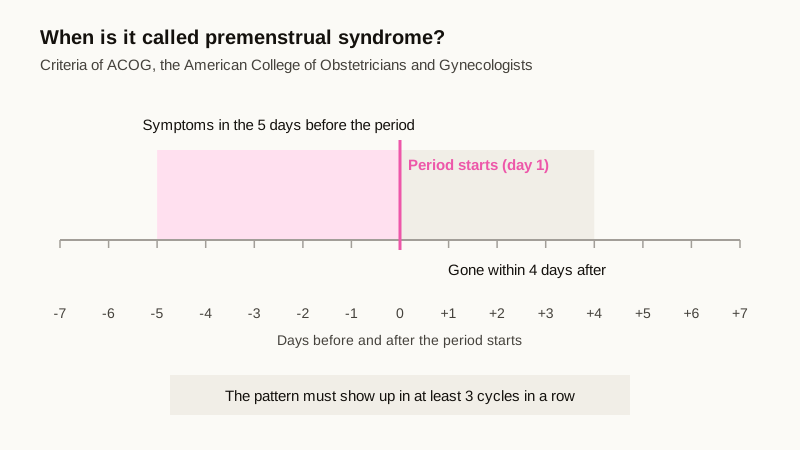
PMS is something else: a set of symptoms that begin a few days before a period. The Assurance maladie lists swollen and tender breasts, a bloated abdomen, swollen hands and feet, irritability or anxiety, and headaches. The American College of Obstetricians and Gynecologists (ACOG) gives a definition anchored in the dates of the cycle: symptoms present in the 5 days before a period, over at least three cycles in a row, that end within 4 days of its start.
The severe form has a name of its own: premenstrual dysphoric disorder, in which mood comes to the fore. A meta-analysis of 44 studies and 50,659 participants, published in 2024 in the Journal of Affective Disorders, puts its frequency at 3.2% when the diagnosis is confirmed by daily tracking over two cycles, and at 7.7% on a provisional diagnosis.
What research has measured on CBD
There is no published controlled trial of CBD in PMS or primary dysmenorrhoea. The only registered trial that comes close, NCT04091789, was filed in the United States in 2019 by a company: a tablet combining 30 mg of CBD, 1 mg of THC and palmitoylethanolamide, a single group, no placebo, with 30 participants planned. Its status is "unknown" and no results have been published.
The human data come from surveys. The most recent, published in 2026 in the Journal of Women's Health, questioned 703 people in the United States online, including 634 who had menstruated in the past year and 167 with premenstrual dysphoric disorder. To manage their mood before a period, 30.0% used cannabis and 16.1% used alcohol; in the group with the dysphoric disorder, 51.5% used cannabis, mostly in the two weeks before a period. There are three limits: the sample selected itself, the study measures use and not effect, and it covers cannabis in general, THC included.
Another survey, carried out in 2024 in Germany, Austria and Switzerland among 912 people with endometriosis, counted 114 cannabis users, recruited through patient groups on social media. Our article on CBD and endometriosis sets out what these self-reports are worth. A 2022 narrative review concludes that cannabis is a "promising" avenue, but the trials it lists concern pain in general, not periods.
Pointing the other way, the food safety commission of the German Research Foundation (SKLM) reviewed the data in 2025. It found no scientific evidence supporting a health claim for CBD at the doses found in food products, menstrual health included. For an overview, see our summary of what clinical studies say about CBD.
What French law allows anyone to say
MILDECA, the French interministerial mission for combating drugs, spells it out: products containing CBD may not make therapeutic claims, on pain of criminal penalties, unless they have been authorised as a medicine. The only authorised medicine based on cannabidiol is Epidyolex, prescribed in certain rare epilepsies; our article on Epidyolex sets out the framework. A shop promising that an oil will "calm period pain" is therefore breaking the law, and that is a good sign to take your business elsewhere.
The sale itself is governed by the threshold of 0.30% Δ⁹-THC in the finished product. The Conseil d'État decision of 29 December 2022 overturned the ban on selling raw flowers and leaves. When swallowed, CBD also falls under the novel food regime, described in our overview of CBD regulation in 2026.
Precautions if you use CBD during your cycle
The dose. On 9 February 2026, EFSA set a provisional limit of 0.0275 mg of CBD per kilo of body weight per day, or about 2 mg a day for a 70 kg adult. It applies to food supplements made from CBD that is at least 98% pure. The agency states that safety cannot be established under the age of 25, during pregnancy or breastfeeding, or in people who take medication. Our article on EFSA's reference dose walks through the calculation.
Medicines. The European product information for Epidyolex states that CBD is broken down by the liver enzymes CYP3A4 and CYP2C19 and that it multiplies exposure to the active metabolite of clobazam by 3 to 4. The same document does not mention hormonal contraceptives: no interaction is documented there, which is not proof that none exists. If you take any treatment, anti-inflammatories included, talk to your pharmacist. The mechanism is explained in our article on the grapefruit effect.
Pregnancy. Trying to conceive, pregnancy and breastfeeding are situations in which CBD is advised against; the reasons are in our article on CBD during pregnancy.
When to see a doctor rather than wait
For painful periods, the Assurance maladie first recommends heat, such as a hot water bottle or a warm bath, and gentle physical activity such as walking or swimming. It describes anti-inflammatories as the most effective medicines, taken early, at the lowest effective dose and for 2 to 3 days at most.
It also lists the situations that call for a consultation:
- pain that anti-inflammatories do not ease, or that lasts beyond a few days;
- pain that first appears in adulthood, or that gets worse from one cycle to the next;
- pain that stops you from doing your usual activities;
- fever, unusual discharge, bleeding between periods or very heavy periods;
- pain during sex.
These signs can point to a cause that needs treatment, such as endometriosis. No wellbeing habit, CBD included, should delay that appointment.
Frequently asked questions
Can CBD reduce period pain?
No controlled study allows anyone to say so. The published surveys measure reported cannabis use, not an effect of CBD, and the law forbids attributing a therapeutic effect to a CBD product. If the pain is severe, the Assurance maladie guidance remains the reference.
What is the difference between PMS and premenstrual dysphoric disorder?
PMS groups together physical and emotional symptoms in the days before a period. Premenstrual dysphoric disorder is its severe form, dominated by mood, and affects 3.2% of people who menstruate on a confirmed diagnosis.
Can I take CBD every day of my cycle?
Nothing forbids it for a compliant product, but EFSA's provisional limit for supplements is about 2 mg a day for a 70 kg adult. If you take medication, are pregnant or are under 25, EFSA considers that safety has not been established.
Does CBD interact with the pill?
The Epidyolex product information does not mention any interaction with hormonal contraceptives. CBD passes through liver enzymes that break down many medicines, so the question is a fair one: a pharmacist can check your situation.
Written by the Phytogrammes team
Every article in this journal draws on primary sources (ANSM, EFSA, EUR-Lex, peer-reviewed publications) and on the lab's own practice: batch-by-batch HPLC analyses, measured cannabinoid profiles. Our approach.
Article published on . CBD is not a medicine.