← Journal/18 May 2026·8 min de lecture
Dogs and thunderstorms: how to soothe yours without needless medication
Par The Phytogrammes team ·
Around one dog in three suffers from a storm phobia, according to veterinary behaviourists. The validated methods combine a safe den, gradual desensitisation, synthetic pheromones, compression garments and — for marked cases — an occasional veterinary anxiolytic on prescription.
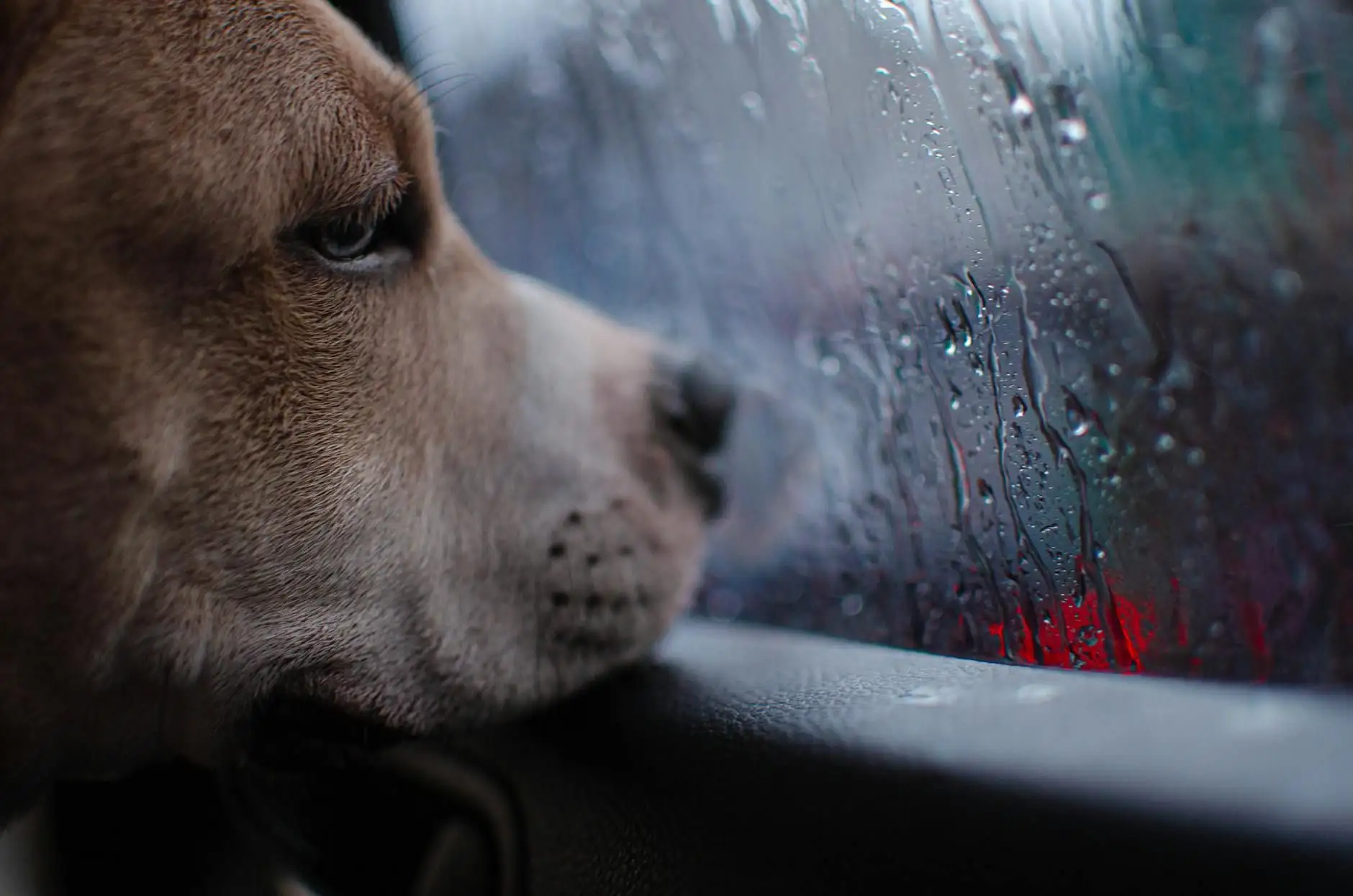
A thunderstorm triggers a triple aversive stimulation in dogs: noise (thunder), flashes of light, and barometric changes perceptible from the approach phase onwards. Identifying the signals, anticipating them and structuring the response makes the difference between mild discomfort and an entrenched phobia.
Why so many dogs fear thunderstorms
Several factors add up:
- Acute hearing: a dog perceives sounds up to 45,000 Hz (against 20,000 in humans) and with a greater perceived intensity.
- Barometric sensitivity: the rapid drop in pressure precedes the storm by 30 to 60 minutes. The dog may "sense" the storm before the first human-detectable signs.
- Static electricity: the coat can accumulate static electricity during the stormy phase, causing small unpleasant discharges.
- Associative memory: a bad storm experience leaves a lasting mark, especially if it happened in isolation.
The signals to recognise
Before the storm, the dog may:
- Pace up and down.
- Pant with no thermal reason.
- Look for a dark corner (cupboard, under the stairs, bathroom).
- Stick very close to its human.
- Refuse to eat.
During the storm:
- Generalised trembling.
- Excessive drooling.
- Vocalisations (barking, whining, howling).
- Escape attempts (scratching at doors, jumping over gates).
- Indoor accidents (in an otherwise house-trained dog).
After the storm:
- Gradual recovery over 30 to 90 minutes.
- Excessive vigilance persisting for several hours.
7 effective levers to soothe a storm-fearing dog
1. Prepare a safe den
The dog needs a corner it has chosen itself or that has been set up for it: a bed in an interior room with few windows, a nook under a piece of furniture, a thick blanket in an open cupboard. The den is never locked shut — being shut in amplifies panic.
2. Diffuse calming pheromones
Diffusers of synthetic pheromones (Adaptil® in France, from veterinary pharmacies) mimic maternal pheromones. Several studies validate them for noise phobias. Switch on 30 minutes before the forecast storm and leave plugged in for several hours.
3. Use a compression garment
The Thundershirt and equivalents wrap the animal in gentle compression. The principle is analogous to the calming effect of swaddling on babies. Efficacy documented in roughly 60-70% of phobic dogs. To be put on before panic sets in.
4. Mask the noise
White noise, gentle music (the "Calming for Dogs" playlists on Spotify include tested frequencies), television on low. The aim: to lower the sound contrast between thunder and the surrounding environment.
5. Desensitise gradually
Outside storms, play the dog a storm soundtrack at very low volume, pairing it with play or treats. Increase the volume gradually over several weeks. A validated method, but a slow one, ideally run with a veterinary behaviourist.
6. Stay calm and neutral
Dogs read human emotions. A calm, ordinary attitude is more reassuring than excessive attention. Do not punish fearful behaviour: that makes the phobia worse. Nor should you over-console, which can reinforce the behaviour.
7. Exercise before the stormy phase
If you are expecting a storm (Météo-France alerts), take your dog out for a long walk during the day. A physically tired dog shows less emotional reactivity.
When to consult the vet
Grounds for a consultation:
- A long-standing phobia resistant to environmental adjustments.
- Self-injury or dangerous escape attempts.
- Combination with other phobias (fireworks, separation).
- An older dog that suddenly develops a fear of storms (suspected cognitive impairment).
The vet can:
- Prescribe an occasional veterinary anxiolytic (for example Sileo, dexmedetomidine oromucosal gel).
- Refer you to a veterinary behaviourist for a structured desensitisation protocol.
- Check for underlying pain that would amplify the anxiety.
A few seasonal good practices
In France, the storm season runs from May to September, peaking in June and July. A few useful precautions:
- Follow Météo-France alerts: the free app sends notifications ahead of forecast storms.
- Plan for 14 July and 31 December: fireworks and firecrackers generate reactions identical to storms. Go out before sunset, close windows and shutters, and make sure the animal's identification is up to date in case it bolts.
- Staying indoors is generally preferable to a walk during the storm: take your dog out before the storm arrives or after.
- Check the I-CAD identification: a dog that runs off during a storm needs to be findable. A microchip without up-to-date contact details is useless.
- Keep your vet informed about any anxiolytic prescription: for dogs with a severe phobia, an occasional protocol administered 30 minutes before the storm begins may be proposed.
CBD for dogs and thunderstorms: what French regulations say
No veterinary medicine based on CBD has obtained a marketing authorisation issued by the ANMV (official index). The sale of CBD products "for animals" is tolerated without recognised therapeutic validation. A vet may prescribe CBD off-label under the therapeutic cascade (EU Regulation 2019/6).
Practical framework:
ANSES reported in 2024 an increase in animal poisonings linked to contaminated CBD products.
Key points
- Around 1 dog in 3 fears storms, according to behaviourists.
- Safe den + pheromones (Adaptil®) + compression garment: the basic trio.
- Gradual desensitisation: the long-term lever, slow but lasting.
- Never punish, and don't over-console either.
- See a vet if the phobia is resistant or the symptoms are severe.
- Veterinary CBD: professional advice mandatory, THC-free isolate, CoA.
Frequently asked questions
My dog is scared of the 14 July fireworks — is it the same thing?
Very close, yes. The same methods apply (den, pheromones, sound masking). 14 July and 31 December are the two annual peaks for canine accidents and runaways in France. Plan ahead: go out before sunset, close windows and shutters, and check your animal's identification.
Can you give a dog a human sedative?
No. Human anxiolytics (benzodiazepines, antihistamines) can be toxic or ineffective in dogs. Only a vet can prescribe a suitable anxiolytic.
At what age does a storm phobia develop?
Most often between 1 and 4 years old, sometimes later after a striking experience. A sudden onset in an older dog warrants a consultation — it may signal cognitive dysfunction or underlying pain.
Does the Thundershirt really work?
Several veterinary studies show an improvement in 60-70% of phobic dogs, especially alongside other measures. Try it before the first real-world use: have the dog wear the garment for a few minutes in a calm setting.
How do I know whether my dog needs medication?
If, despite environmental adjustments, the phobia remains severe (panic, flight, injuries), an occasional anxiolytic on veterinary prescription is legitimate. It does not replace behavioural measures: it makes them possible.
To discover our selection of hemp products for animal well-being — always on your vet's advice — [see our stress and anxiety catalogue](/categorie-produit). CBD is not a medicine. In case of severe phobia or behavioural disorders, consult a vet or a qualified behaviourist.
Sources
Written by the Phytogrammes team
Every article in this journal draws on primary sources (ANSM, EFSA, EUR-Lex, peer-reviewed publications) and on the lab's own practice: batch-by-batch HPLC analyses, measured cannabinoid profiles. Our approach.
Article published on . CBD is not a medicine.
Phytogrammes products that pair well




Further reading

chanvre·18 May 2026
Five things to know about hemp, seen from France
A farm crop thousands of years old, an industrial resource, a source of CBD: a factual overview of hemp in the French and European context.

cbd·18 May 2026
Five common questions about CBD: answers for France
Why hemp, how do you dose it, is it legal, is it risk-free, who should avoid it? The answers within the French framework in 2026.

cbd·18 May 2026
How long does CBD take to take effect?
How long CBD takes to act depending on the route of administration, the recommended assessment window and the known pharmacokinetic limits. Practical markers for a wellbeing routine.