← Journal/18 May 2026·9 min de lecture
Stress in France: which cities concentrate the most pressure?
Par The Phytogrammes team ·
Nearly 9 French people out of 10 report feeling stressed, according to the 2022 IFOP barometer. The most exposed areas combine four factors: urban density, commuting time, financial pressure linked to housing, and ambient noise. Paris, the inner suburbs and saturated regional metropolitan areas come top.
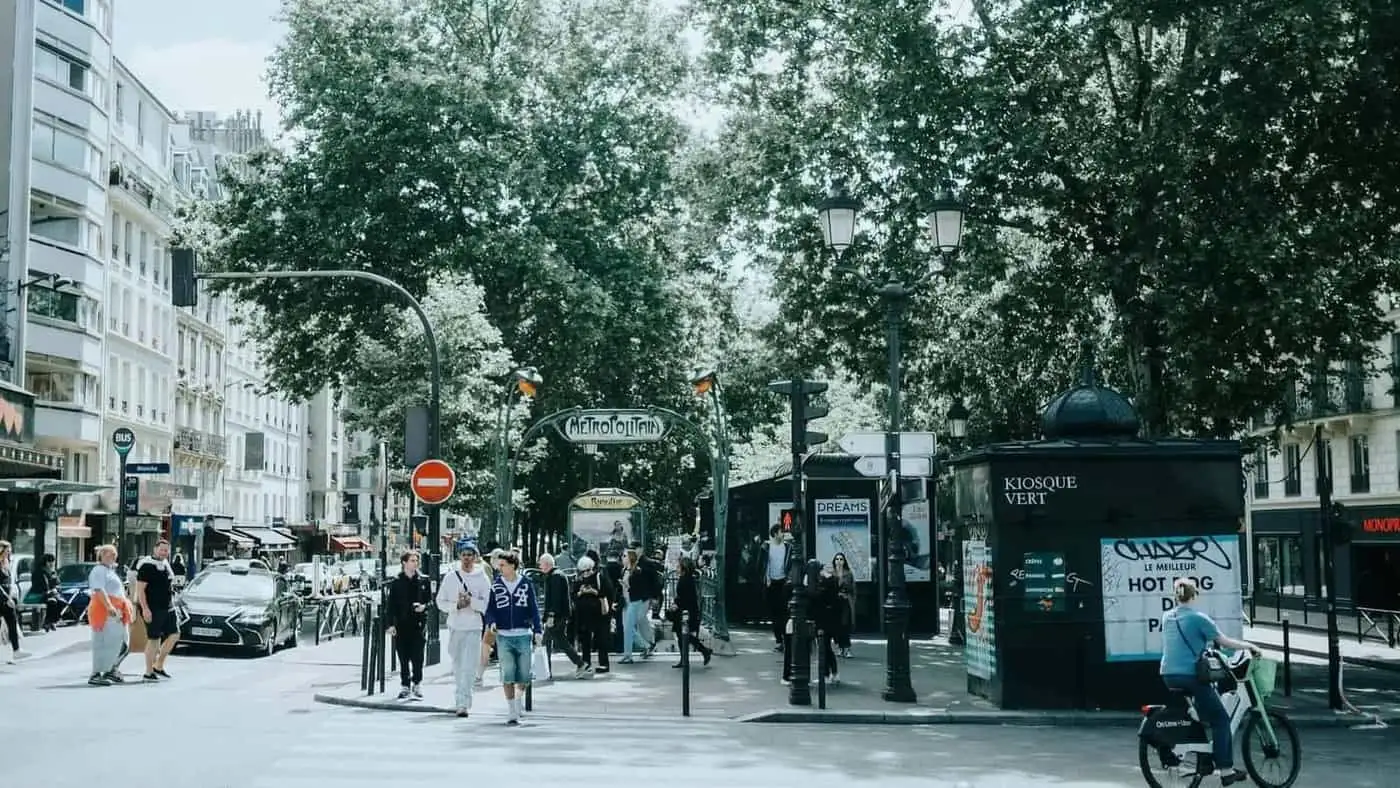
No French public authority currently publishes an official ranking of the "most stressed cities". The reliable data come from cross-referenced sources: IFOP surveys, the Santé publique France mental health barometer, Insee statistics on commuting times and housing costs, and Inserm observations on urban health. This article brings these data together to draw a reasoned map — without inventing a league table that does not exist.
What stress really weighs among the French
According to the 2022 IFOP survey commissioned by 60 millions de consommateurs, 89% of French people say they have already felt stress or anxiety, and 43% indicate that this feeling is frequent in their daily lives. Working city dwellers aged 25 to 44 are the most exposed segment. Inserm points out that chronic stress — as opposed to acute, one-off stress — durably increases cardiovascular and metabolic risks as well as the risk of anxiety and depressive disorders.
In definitional terms, the World Health Organization describes stress as "a state of worry or mental tension caused by a difficult situation". A moderate and brief response is physiological; its prolonged repetition becomes a health risk factor.
Four geographical determinants of stress
Public studies converge on four dimensions that mechanically amplify stress when you live in a large city.
1. Density and noise
Insee measures population density per km². Paris proper peaks at more than 20,000 inhabitants/km², compared with 2,800 for Lyon, 2,400 for Marseille, 1,400 for Bordeaux and 580 for a mid-sized city such as Limoges. Chronic noise (traffic, neighbours, building sites) is listed by Santé publique France as a documented stress factor, associated with sleep disturbance and an average rise in blood pressure.
2. Home-to-work commuting time
The Insee "Conditions de vie" survey shows that residents of the Île-de-France region spend an average of 68 minutes a day in transport, compared with 50 minutes for inhabitants of other metropolitan areas and 35 minutes in rural areas. Beyond 45 minutes per journey, several European studies identify a perceptible deterioration in subjective well-being.
3. Housing pressure
Tight housing markets — Île-de-France, the Côte d'Azur, the conurbations of Lyon, Bordeaux, Nantes and Annecy — show a housing cost-to-income ratio above 30% for the least well-off third of households. The 30% threshold is the one used by Insee to define a situation of financial overburden. In Paris, the median exceeds 35% among private-sector tenants.
4. Financial precariousness
The 2021 mental health barometer from Santé publique France indicates that people in a situation of financial precariousness report two to three times more anxiety and depressive symptoms than well-off households. Yet the départements with high poverty rates — Seine-Saint-Denis (28%), Pyrénées-Orientales (20%), Aisne (19%) — are also where these tensions are most visible in the cities.
The most exposed French areas (indicative reading)
Based on the four determinants above, and without claiming to offer an official ranking, the areas that combine the most stress factors are:
- Paris and the inner suburbs (75, 92, 93, 94): record density, long commuting times, saturated housing.
- Seine-Saint-Denis: the most marked financial precariousness in Île-de-France, with young people exposed to an accumulation of tensions.
- Marseille proper: precariousness in the northern districts, perceived insecurity, property pressure in the centre.
- Lyon Part-Dieu and the 3rd arrondissement: density of offices, traffic jams, rental pressure.
- Nice and the coastal strip of the 06: housing costs among the highest in the country, economic seasonality.
- Saint-Denis (La Réunion), Pointe-à-Pitre: overseas départements and regions showing fragile health indicators.
Conversely, mid-sized towns of fewer than 100,000 inhabitants in the Atlantic South-West (Pau, La Rochelle), in inland Brittany (Vannes, Quimper) or in the renewed Massif Central (Clermont-Ferrand, Aurillac) regularly come out at the top of the "best places to live" rankings published annually by Le Journal du Dimanche and the Association des villes et villages où il fait bon vivre — with no public-authority standing, but useful as a benchmark.
"Urban stress" is not inevitable
Living in a large city does not mechanically imply poor mental health. Inserm stresses that access to green spaces, the quality of the local social fabric, the sense of control over one's time and commute, and the regularity of sleep strongly modulate how it is experienced. A 2023 Santé publique France study showed that Parisians living less than 500 metres from a park or garden reported a well-being score 12% higher than those who lived further away.
Three personal levers recur in all public recommendations:
- Walk for 30 minutes a day, ideally outdoors in the morning.
- Cap screen time after 8 p.m. to protect the ability to fall asleep.
- Preserve a weekly recovery period free of work demands.
CBD in this landscape: a complement, not an answer
The French CBD market tripled between 2021 and 2024, reaching roughly €850m according to the UPCBD/AFPC estimate. The most frequently reported use is precisely the management of stress and anxiety (approx. 43% of users surveyed by IFOP). That said, neither the ANSM, nor the HAS, nor the EFSA has validated a health claim for wellness CBD. The official MILDECA page on CBD points out the absence of any demonstrated therapeutic benefit and the risk of a positive saliva test for THC.
In practice, wellness CBD can be built into a relaxation routine — an evening infusion, a sublingual oil after a busy day — without claiming to replace medical care. It is legal in France if the finished product contains at most 0.30% THC, in line with the Conseil d'État decision of 29 December 2022. Synthetic cannabinoids (HHC, H4CBD, THCP) have been banned since 2024.
When urban stress becomes a warning signal
The CoviPrev survey by Santé publique France showed that in 2024 one French person in five presents clinically significant depressive or anxiety symptoms. The signals not to ignore:
- Insomnia lasting more than three weeks in a row.
- Persistent digestive problems with no identified cause.
- Overwhelming anxious rumination that prevents you from functioning.
- Progressive social avoidance.
- Dark thoughts, even fleeting ones.
In such cases, the first point of entry is the general practitioner, who can refer patients to cognitive behavioural therapy (CBT), reimbursed under the "Mon soutien psy" scheme since 2024 (12 sessions a year with an approved psychologist).
Key points
- 89% of French people report feeling stress (IFOP 2022); 43% frequently.
- The four urban factors that aggravate stress: density, transport, housing, precariousness.
- Paris, the inner suburbs, Marseille proper and Nice combine these determinants.
- No official league table of the "most stressed cities in France" is published by the public authorities.
- Access to a green space within 500 m raises the reported well-being score.
- Wellness CBD is a possible complement to a relaxation routine, not a treatment.
Frequently asked questions
Is there an official ranking of the most stressed cities in France?
No. No public institution (Insee, Santé publique France, the Ministry of Health) publishes such a ranking. Comparisons are reconstructions from partial data: Insee density figures, the IFOP barometer, local ARS surveys. Media league tables should be read as indications, not as consolidated measurements.
Is stress really higher in Paris than in the provinces?
Several indicators converge: longer commuting times, higher housing costs, greater density, more marked exposure to noise. The IFOP barometer nevertheless shows that the gaps between regions are modest — stress is a national phenomenon.
Can CBD help in coping with urban stress?
No French or European authority has validated a claim. Consumers report using it to accompany a relaxation routine. CBD fits into an overall approach — sleep, diet, physical activity — and does not replace medical advice in cases of chronic stress.
How do I know whether my stress is becoming pathological?
If your symptoms (insomnia, rumination, fatigue, digestive problems) last more than three weeks and impair your daily life, consult your general practitioner. The "Mon soutien psy" scheme gives access to 12 reimbursed psychologist sessions a year.
What simple steps help you breathe in the city?
Getting out into the open air for 20 minutes in the morning, walking at least 30 minutes a day, limiting screen exposure in the evening, and preserving a weekly period free of demands. These levers are endorsed by Inserm and Santé publique France.
To discover our selection of hemp products intended to accompany a moment of relaxation, [see our stress and anxiety catalogue](/categorie-produit). CBD is not a medicine. In the event of persistent anxiety or an anxiety disorder, consult a healthcare professional.
Sources
- EFSA Journal 2026 — Update statement CBD novel food — primary
- Xerfi — Le marché du CBD en France (DIS104, updated 2024-2025) — secondary (paid report, figures relayed by the press)
- Xerfi via Revue des Tabacs — "+50% in 2023" — secondary
Written by the Phytogrammes team
Every article in this journal draws on primary sources (ANSM, EFSA, EUR-Lex, peer-reviewed publications) and on the lab's own practice: batch-by-batch HPLC analyses, measured cannabinoid profiles. Our approach.
Article published on . CBD is not a medicine.
Phytogrammes products that pair well



Further reading

chien·18 May 2026
Travelling with your dog stress-free: the practical guide
Train, car, plane, accommodation: the French and European rules for going on holiday with your dog, and the limits of veterinary CBD.
voyage·18 May 2026
Flying with CBD: France, Europe and outside the EU
Can you fly with your CBD? French rules, intra-Schengen flights, destinations outside the EU and container sizes: what you need to know before boarding.

420·16 May 2026
420: the history, origin and myths surrounding cannabis
The true story behind the best-known cannabis symbol in the world, between legend and verified fact.