Why 420? The true story of cannabis's code number
"420" comes from a time of day. In 1971, five students in San Rafael, California, met at 4:20 pm (16:20) to go looking for a cannabis patch they never found. The code spread through the Grateful Dead's circle, then High Times magazine took it wide from 1991, along with the date of April 20. It is neither a police code nor a section of law, and April 20 has no legal meaning in France.
Contents
> Key takeaways > > - Origin: five students at San Rafael High School, the "Waldos", who met at 4:20 pm by a statue of Louis Pasteur in 1971. > - Spread: a flyer handed out in Oakland on 28 December 1990 called for smoking on April 20 at 4:20 pm; High Times printed it in 1991. > - Section 420 of the California Penal Code exists, but it concerns access to public land. > - In France, cannabis use is still a criminal offence: 1 year and a €3,750 fine, or a €500 fixed fine since 20 August 2026. > - CBD falls under a different regime, set by the 0.30% Δ⁹-THC limit, which does not depend on any date.
The documented origin: the Waldos of San Rafael, 1971
This is the best-supported story of all, because its authors kept evidence. In 1971, five students at San Rafael High School, north of San Francisco, formed a group. Steve Capper, Dave Reddix, Jeffrey Noel, Larry Schwartz and Mark Gravich called themselves the "Waldos", because they gathered by a wall at the school, Time magazine reports.
They met at 4:20 pm by the statue of the chemist Louis Pasteur, once after-school activities were over. The goal: to find a cannabis patch that a member of the Coast Guard was growing near the Point Reyes peninsula. A hand-drawn map had reached them. They never found it, reports CBS San Francisco.
The password "420 Louis" shrank to "420", and the code outlived the treasure hunt. According to Time, it now served as a code word for cannabis itself. To prove they came first, the Waldos kept letters postmarked in the mid-1970s in which the term appears.
From high school to the world: the Grateful Dead, then High Times
Dave Reddix's brother helped him become a roadie for Phil Lesh, the Grateful Dead's bass player. Through that network, the code entered the circle of the musicians and their fans, the "Deadheads".
The turning point came at the end of 1990. On 28 December, Deadheads in Oakland handed out a flyer inviting people to smoke "420" on April 20 at 4:20 pm. Steve Bloom, then a reporter at High Times, picked one up. The magazine printed it in 1991 and kept using the number afterwards. April 20 is written 4/20 in American date notation: the time of day became a yearly date.
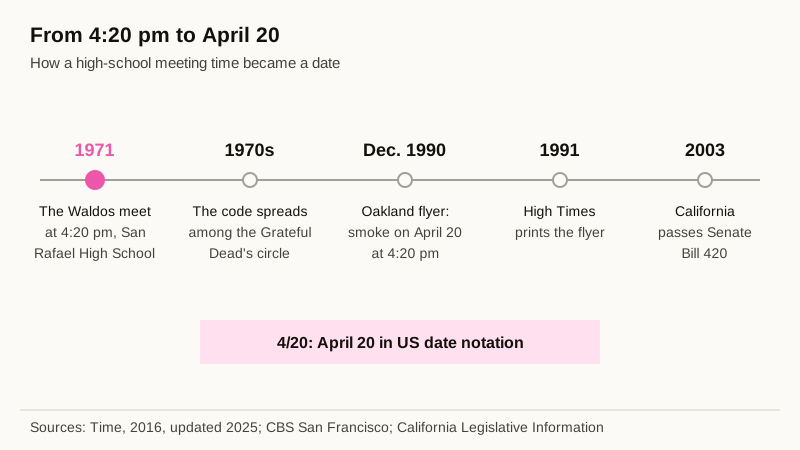
The number even ended up in California law. The bill that set up the state's medical cannabis programme, approved by the governor on 12 October 2003, is called Senate Bill 420.
The myths to set aside
Several explanations still circulate. Time rules out the first three in the table; the other two can be checked against the texts.
| Explanation you may hear | What is true |
|---|---|
| A US police radio code for cannabis | No such code is documented. |
| Bob Dylan's song "Rainy Day Women #12 & 35", because 12 × 35 = 420 | A coincidence of arithmetic, noticed after the fact. |
| Adolf Hitler's birthday, since he was born on an April 20 | A coincidence of dates, unrelated to the Waldos. |
| Section 420 of the California Penal Code would target cannabis | It exists, but it punishes blocking access to public land. |
| Cannabis would contain 420 chemical compounds | A 2017 review lists more than 560 identified constituents. |
None of these leads stands up against the Waldos' evidence. The high-school version is the only one backed by documents from the time.
April 20 in France: a date with no legal meaning
In France, April 20 is sometimes picked up on social media or by campaign groups. It changes nothing in law. Using cannabis is a criminal offence, punished under article L3421-1 of the Public Health Code by 1 year in prison and a €3,750 fine. Since 20 August 2026, the fixed fine that can replace prosecution is €500, €400 if paid quickly, €1,000 if increased for late payment.
Marking the date is not banned as such, and a gathering falls under the ordinary rules on public events. However, article L3421-4 punishes incitement to drug use with 5 years in prison and a €75,000 fine, even when it has no effect. A poster or a promotion inviting people to smoke cannabis on April 20 can fall under this text.
An overview of the penalties, with figures, is in our article on French cannabis law.
What 420 does not change for CBD
CBD comes from the same plant, but its legal regime is separate. A hemp product may be sold if it contains no more than 0.30% Δ⁹-THC, the limit set by the order of 30 December 2021. On 29 December 2022, the Conseil d'État annulled the ban on flowers and leaves that this order contained. These rules apply all year round, April 20 included.
Two other points hold all year too. CBD is not a medicine, except Epidyolex, which is prescribed for certain forms of epilepsy. And a full-spectrum product can trigger a saliva test, as our article on CBD and driving explains. For the difference between the two plants, see hemp, cannabis, marijuana, and for the basics, what is CBD.
Frequently asked questions
Why does 420 mean cannabis?
Because five California students met at 4:20 pm in 1971 to look for a cannabis patch. "420" became their code word, then that of the Grateful Dead's circle, before High Times spread it from 1991.
Is 420 a US police code?
No. No source documents a police radio code 420 for cannabis. Section 420 of the California Penal Code exists, but it concerns access to public land.
Why April 20?
Because April 20 is written 4/20 in American notation. The flyer handed out in Oakland on 28 December 1990 already called for smoking on that day, at 4:20 pm.
Does April 20 have any status in France?
No. It is a cultural date with no official recognition. Cannabis use is punished on that day like any other, and incitement to use is a criminal offence.
Does 420 have anything to do with legal CBD?
No legal link at all. CBD is sold in France under the 0.30% Δ⁹-THC limit, which does not depend on any date. Shops must still, on that day as on any other, avoid presenting drug use in a favourable light.
Written by the Phytogrammes team
Every article in this journal draws on primary sources (ANSM, EFSA, EUR-Lex, peer-reviewed publications) and on the lab's own practice: batch-by-batch HPLC analyses, measured cannabinoid profiles. Our approach.
Article published on . CBD is not a medicine.