Gorilla Glue #4: the 2012 accident and the 2017 lawsuit
Gorilla Glue #4 is an American cannabis strain born around 2012 from an unplanned pollination between three plants, Chem's Sister, Sour Dubb and Chocolate Diesel. Its breeders, known by the pseudonyms Josey Whales and Lone Watie, named it after a glue; the manufacturer sued them in 2017, and the strain has been called GG4 ever since. In France, a flower sold as "Gorilla Glue CBD" often shares nothing with it but the name.
Contents
> Key takeaways > > - The strain was born around 2012 at GG Strains, a Nevada company, from a cross its breeders had not planned. > - The name comes from a resin so sticky that the breeder's phone reportedly stuck to his hand. > - On 24 March 2017 the maker of Gorilla Glue sued in a federal court in Ohio; the settlement imposed the name GG4. > - An Italian hemp variety sold as "Gorilla Glue", analysed in 2022, descends from an industrial hemp variety. > - A CBD flower is judged on its batch analysis: no more than 0.30% Δ⁹-THC, whatever its name.
Who created Gorilla Glue, and how
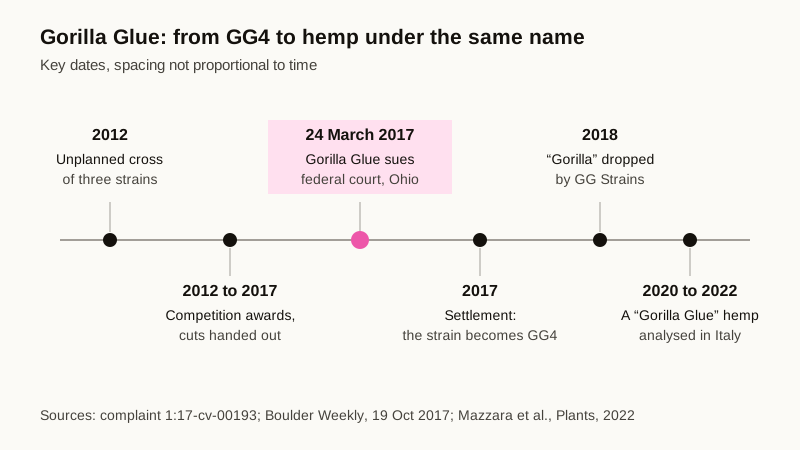
Gorilla Glue #4 comes from GG Strains, a Nevada company based in Las Vegas. According to the complaint filed against it in 2017, it was founded by two men going by the names Josey Whales and Lone Watie, who say they are the original breeders of the strain. The document states that they entered it in competitions and distributed hundreds of cuts of it to growers.
The origin story is short. According to a Boulder Weekly article from October 2017, the strain was born in 2012 from an "accidental liaison" between Chem's Sister, Sour Dubb and Chocolate Diesel plants. The number refers to a phenotype, meaning one plant selected among those offspring: GG Strains also sold Gorilla Glue #1 and #5.
The name comes from an anecdote the complaint repeats. After trimming the flowers, Josey Whales reportedly noticed his phone was stuck to his hand, and said the plant made him "stick to things like Gorilla Glue", an American glue brand. The same paper reports that within a few years the strain was winning several Cannabis Cups, strain competitions held in the United States.
The 2017 lawsuit: a glue against a plant
The glue maker was not pleased. On 24 March 2017, The Gorilla Glue Company, an Ohio business, sued GG Strains in the US District Court for the Southern District of Ohio, case no. 1:17-cv-00193. The complaint alleges trademark infringement, trademark dilution, unfair competition and cybersquatting, the abusive use of a domain name.
Its central argument is commercial. According to the complaint, consumers associate "sticky" resin with high-quality cannabis, and GG Strains allegedly chose the name to trade on the glue's fame. The case was settled out of court the same year. According to the Boulder Weekly, the settlement renamed the strains GG4, GG1 and GG5, gave GG Strains twelve months to stop using the word "Gorilla" and gorilla images, and gave licensed growers and dispensaries 90 days to adopt the new names.
The original name did not disappear, though. It still appears on CBD flowers sold in Europe, where the American settlement does not apply.
Why such a resinous strain spread so widely
Gorilla Glue's resin is that of the trichomes, the tiny glands covering the female flowers. A study published in 2020 in Scientific Reports notes that cannabinoids and terpenes are produced and stored there. A plant heavily covered in trichomes therefore yields a lot of material for extracts and hash, which interests growers and resin makers alike. Our article on trichomes explains their role in the plant.
Distribution did the rest: hundreds of cuts handed out, competition awards and a name that is easy to remember. It is the classic path of a cult strain, much like that of OG Kush, whose name also travelled far beyond the original plant.
A strain name does not guarantee genetics
The further a name travels, the less it tells you about what is in the bag. A study published in 2019 in the Journal of Cannabis Research analysed the DNA of 122 samples of 30 strains bought from 20 dispensaries in three US states. It found significant genetic differences between samples sold under the same name.
Chemistry fares no better. Across 89,923 samples tested in laboratories in six states, a team concluded in 2022 that commercial labels do not consistently match the measured composition in cannabinoids and terpenes. Neither study looked at Gorilla Glue specifically, and we found no measurement of the original GG4's terpene profile published in a scientific journal. The "peppery, earthy, diesel" profiles circulating online come from commercial websites.
Gorilla Glue CBD: the same name, a different plant
In Europe, the name turns up on low-THC hemp. An Italian team published in 2022 in the journal Plants an analysis of nine commercial hemp varieties, one of them sold as "Gorilla Glue". The authors state that it derives, like the 24 K variety, from the industrial variety Carmagnola CS: nothing therefore points to a family link with the American GG4.
Their measurements, on flowers harvested in autumn 2020, describe a CBDA-rich hemp with an unusual aroma profile:
| Measurement (Mazzara et al., 2022) | Italian "Gorilla Glue" |
|---|---|
| CBDA in the dried flower | 63.5 mg per gram, or about 6.4% |
| THC in the essential oil | below 0.2% |
| Dominant terpene family | sesquiterpenes |
| Main terpene | (E)-caryophyllene |
| Distinguishing terpenes | selina-3,7(11)-diene, 12.5% of the essential oil |
(E)-caryophyllene is another name for beta-caryophyllene, a peppery terpene covered in detail in our article on beta-caryophyllene. This profile applies to that plant and that batch, not to everything sold under the name.
In France, a flower is legal if it comes from a variety listed in the EU or French catalogue and the finished product contains no more than 0.30% Δ⁹-THC. The Conseil d'État struck down on 29 December 2022 the ban on selling raw flowers. Our guide to the EU catalogue of hemp varieties explains why a flower's trade name often differs from its listed variety.
Phytogrammes does not sell a flower under this name. To compare the flowers in the CBD flowers category, our checklist for choosing CBD on verifiable criteria starts from the batch analysis, never from the name.
Frequently asked questions
Who created Gorilla Glue?
Two breeders at GG Strains, a Nevada company, who go by the pseudonyms Josey Whales and Lone Watie. According to 2017 press reports, the strain was born in 2012 from an unplanned cross between Chem's Sister, Sour Dubb and Chocolate Diesel.
Why is Gorilla Glue also called GG4?
Because the maker of Gorilla Glue sued GG Strains for trademark infringement in March 2017. The settlement reached the same year renamed the strains GG4, GG1 and GG5.
Is Gorilla Glue CBD legal in France?
Yes, if the flower comes from a hemp variety listed in the catalogue and the finished product contains no more than 0.30% Δ⁹-THC. The name proves nothing: only the batch analysis confirms it.
Does Gorilla Glue CBD taste like the original?
Nothing supports that claim. The Italian version analysed in 2022 descends from an industrial variety and shows a caryophyllene-dominated profile, and no terpene profile of the original GG4 has been published in a scientific journal.
Written by the Phytogrammes team
Every article in this journal draws on primary sources (ANSM, EFSA, EUR-Lex, peer-reviewed publications) and on the lab's own practice: batch-by-batch HPLC analyses, measured cannabinoid profiles. Our approach.
Article published on . CBD is not a medicine.