CBD cannabutter: 10 mistakes that throw off the dose
CBD butter mostly goes wrong for three reasons: badly managed heat, a starting product of unknown strength, and no calculation. Made with 5 g of flower at 8% CBD in 125 g of butter, it holds up to 32 mg of CBD per 10 g knob, sixteen times EFSA's provisional reference for a 70 kg adult. In France, "cannabutter" can only be made legally with hemp containing no more than 0.30% Δ⁹-THC, and only for yourself.
Contents
> Key takeaways > > - Butter made with THC-rich cannabis is a narcotic in France; only hemp with no more than 0.30% Δ⁹-THC is authorised. > - At 110 °C, it takes about an hour to convert 95% of CBDA into CBD, twice as long as for THCA. > - Butter contains at least 80% fat; half-fat butter only 39 to 41%. > - Stirring CBD oil into soft butter, with no heat, gives a known dose. > - On 20 May 2026, the French Ministry of Agriculture restated that foods containing CBD must be withdrawn from the market.
Mistakes 1 and 2: the starting product and the THC
Mistake 1: starting from a product with no batch analysis. Without the measured CBD percentage, no dose calculation is possible. Without the Δ⁹-THC figure, you cannot tell whether the product complies with the order of 30 December 2021, which sets the threshold at 0.30% for the plant and for extracts. Above it, or with a classified molecule such as HHC, you are no longer making CBD butter but narcotic butter. Our guide to reading a certificate of analysis shows where to find those two lines, and the laboratory page describes the methods.
Mistake 2: forgetting the THC the flower brings. A compliant flower contains up to 0.30% Δ⁹-THC: 5 g brings up to 15 mg, and heating also turns part of the THCA, its acid form, into THC. All of it ends up in the butter. Yet driving after drug use is an offence even when the level found is below the screening threshold: that threshold is for detection, not for punishment, France's Cour de cassation ruled on 21 June 2023, in the case of a driver who said he had taken CBD. Our guide to saliva testing gives the known detection windows.
Then there is food law. CBD butter is a food, and CBD added to food has no authorisation under the novel food rules. On 20 May 2026, the French Ministry of Agriculture restated that such foods must be withdrawn from the market, online sales included. Making butter at home for yourself is not selling it, but it is your responsibility. Our overview of CBD regulation in 2026 sets out the framework.
Mistakes 3 to 5: heat, too short or too strong
Mistake 3: heating the flower for too short a time. In the flower, CBD is mostly present in its acid form, CBDA. Heat strips a carboxyl group off and turns it into CBD: this is decarboxylation. A kinetics study published in 2016 in Cannabis and Cannabinoid Research measured this reaction on cannabis extracts heated from 80 to 145 °C in a vacuum oven. Its rate constants show that CBDA converts half as fast as THCA.
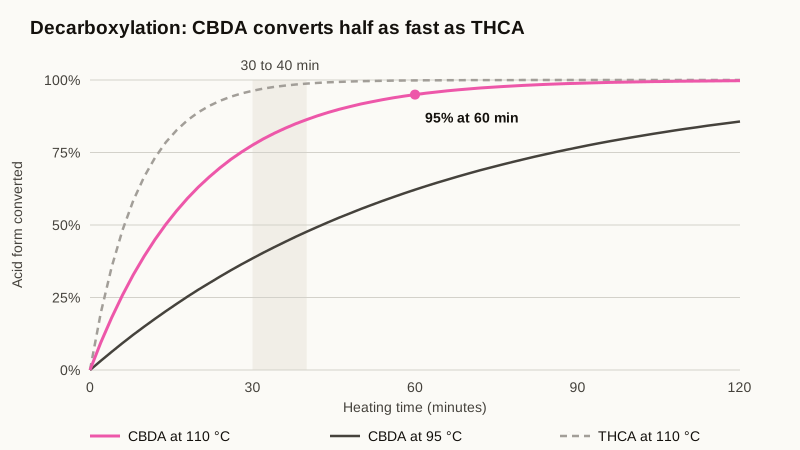
At 110 °C, converting 95% of CBDA therefore takes about 60 minutes, against under 30 minutes for THCA. The 30 to 40 minutes often recommended leave, in theory, 14 to 22% of the CBDA unconverted. These curves describe an extract in a laboratory: flower on a tray, in a home oven that swings by several degrees, will not behave exactly the same. Our article on decarboxylation compares methods.
Mistake 4: decarboxylating a CBD oil. If your oil's analysis shows CBD and not CBDA, the conversion is already done. Heating it again can only lose CBD.
Mistake 5: boiling or frying the butter. Longer or stronger heat does not make up for a failed decarboxylation. In the 2016 study, the combined CBDA + CBD in an extract fell by 18% as heating went on, through side reactions the authors could not identify. A 2022 study in Frontiers in Chemistry measured more than 80% loss after an hour at 220 °C, with Δ⁹-THC forming. A bain-marie keeps the infusion below 100 °C: that is the boiling point of water, and butter contains water.
Mistakes 6 and 7: the fat and the straining
Mistake 6: using reduced-fat butter. CBD dissolves in fat, not in water. Regulation (EU) No 1308/2013, which defines dairy spreads, reserves the name butter for a product with 80 to 90% fat and at most 16% water. Three-quarter-fat butter contains 60 to 62%, half-fat butter 39 to 41%. Less fat, more water: full butter, or clarified butter, remains the right carrier.
Mistake 7: squeezing the flower through the cloth. Straining through muslin or a fine sieve holds back the plant debris. Wringing the cloth for the last drops pushes fine particles through, which give a grassy taste and a gritty texture. Let it drip, without squeezing.
Mistakes 8 and 9: the dose, never calculated
Mistake 8: weighing nothing. Three figures are enough: the weight of flower, its measured CBD percentage and the weight of butter. The result is a maximum, because some CBD stays in the flower or is lost to heat. Here is what two preparations give, against EFSA's provisional safe level of about 2 mg per day for a 70 kg adult:
| Preparation | Total CBD | CBD per gram of butter | In a 10 g knob |
|---|---|---|---|
| 5 g of flower at 8% in 125 g of butter | 400 mg at most | 3.2 mg at most | 32 mg at most |
| 0.2 ml of 10% oil in 100 g of soft butter | 20 mg | 0.2 mg | 2 mg |
The second line is not cannabutter in the classic sense. It is the simplest and most precise method: soften the butter at room temperature, add the oil measured with a graduated syringe, and mix for a long time. No heat, so no cooking loss, and a known dose. EFSA states that its reference applies to pure CBD and not to people under 25, pregnant or breastfeeding women or people on medication. Our article on how much CBD per day explains that reference.
Mistake 9: dosing the dish instead of the portion. A cake made with 50 g of butter at 3.2 mg per gram holds up to 160 mg of CBD. Cut into eight, that makes 20 mg a slice. Always work out what the portion served contains, and mix thoroughly so each slice gets the same amount. Our guide to cooking with CBD oil gives more examples.
Mistake 10: butter with no label
Infused butter looks like ordinary butter. Without a label, someone will end up spreading it on a slice of bread. Write the date, the word "CBD" and the dose per gram on the container, and keep it out of children's reach.
Cold also protects CBD. A stability study in Scientific Reports, run on e-liquids, measured minimal degradation over 30 days at 4 °C, against about 20% at 37 °C. Keep the butter in the fridge, in a closed, opaque container, and freeze whatever you will not use within the week.
Finally, never serve a dish made with CBD butter to someone without telling them. An informed adult decides on their own portion.
Frequently asked questions
Do I need to decarboxylate before making CBD butter?
With flower, yes: the CBD in it is mostly CBDA. Published measurements point to about 60 minutes at 110 °C to convert 95% of the CBDA. With an oil whose analysis shows CBD, no: the conversion is already done.
Can you make cannabis butter in France?
Not with THC-rich cannabis, which is a classified narcotic. Only authorised hemp, with no more than 0.30% Δ⁹-THC, can be used, and the butter cannot be sold or served in a business.
How much CBD is in homemade butter?
Do the maths: weight of flower × CBD percentage ÷ weight of butter. 5 g of flower at 8% in 125 g of butter gives at most 3.2 mg per gram, or 32 mg in a 10 g knob.
What is the simplest way to make CBD butter?
Stir CBD oil into softened butter with no heat. 0.2 ml of a 10% oil in 100 g of butter gives 0.2 mg per gram, or 2 mg in 10 g, EFSA's provisional reference for 70 kg.
Can I use coconut oil instead of butter?
Yes. CBD dissolves in any fat, and coconut oil contains no water. The dose calculation stays the same: amount of CBD divided by the weight of fat.
Written by the Phytogrammes team
Every article in this journal draws on primary sources (ANSM, EFSA, EUR-Lex, peer-reviewed publications) and on the lab's own practice: batch-by-batch HPLC analyses, measured cannabinoid profiles. Our approach.
Article published on . CBD is not a medicine.