Cooking with CBD oil: heat, dose and the law in 2026
CBD does not cope well with prolonged heat: heated pure at 220 °C for one hour, more than 80% of it breaks down, and part of it turns into THC. It dissolves in fats, not in water. But the main question lies elsewhere: in France, foods containing CBD are not authorised, and EFSA's provisional benchmark, about 2 mg a day for a 70 kg adult, is exceeded by a single slice of cake made with a few millilitres of oil.
Contents
> Key takeaways > > - A 2022 study measured more than 80% loss of CBD after 60 minutes at 220 °C, with Δ⁹-THC and CBN forming. > - CBD is fat-soluble: it spreads through the oil, butter or cream in a recipe, not through water. > - EFSA has set a provisional safe level of 0.0275 mg per kg per day, about 2 mg for 70 kg. > - 3 ml of a 5% oil shared over 6 servings gives 25 mg per serving, more than twelve times that benchmark. > - Since May 2026, the French Ministry of Agriculture has stated that foods containing CBD must be withdrawn from the market.
What heat does to CBD: the published measurements
CBD breaks down faster as the temperature rises and the exposure lasts. The available studies look at pure CBD or CBD in solution, never at a dish: they give orders of magnitude, not an exact loss for your recipe.
| Test conditions | Measured result | Source |
|---|---|---|
| CBD e-liquids, 4 °C, 30 days | Average drop under 5% | Mazzetti et al., 2020 |
| CBD e-liquids, 37 °C, 30 days | Average drop of up to 20% | Mazzetti et al., 2020 |
| Commercial oils, 50 °C over 2 days or 70 °C over 14 days | Sharpest drop in sunflower oil, smaller in MCT oil | Tonoyan et al., 2022 |
| Pure CBD in a sealed vial, 220 °C, 60 minutes | Loss above 80% | García-Valverde et al., 2022 |
The last row comes from a study published in Frontiers in Chemistry. The authors heated 25 mg of CBD at 220 °C for 30 seconds up to one hour. After 60 minutes, more than 80% had gone, partly replaced by Δ⁹-THC, CBN and CBE (cannabielsoin). Heating CBD for a long time does not just destroy it: it can produce the very molecule that the 0.30% legal threshold is meant to limit.
The first two rows come from a stability test published in Scientific Reports, and they matter as much for the cupboard as for the kitchen. Kept cold, CBD in solution stays stable over a month; at 37 °C, it loses up to a fifth. Our guide to storing CBD oil turns this into practical rules.
A cake baked at 180 °C does not bring its batter to 180 °C, and the heat acts for less time than in the test. To our knowledge, no published study measures the loss in a real dish. The rule that comes out of the measurements stays simple: less heat, for less time.
Fat as the carrier, and the choice of oil
CBD is a lipophilic molecule, practically insoluble in water. Poured into a broth, a herbal tea or black coffee, it floats in droplets and spreads poorly. In a fat, oil, butter, cream or egg yolk, it dissolves and spreads through the whole preparation. Our article on so-called water-soluble CBD explains why industry turns to emulsions.
The oil that carries the CBD matters too. A 2022 study in Free Radical Biology and Medicine aged commercial cannabis oils at 50 °C and 70 °C. Unsaturated oils, olive and sunflower, formed free radicals, and the CBD drop was sharpest in sunflower oil. MCT oils, made of medium-chain triglycerides, formed few or none.
The recipes this Journal used to publish relied on the same technique, which follows from these two facts:
- cook the base first, then add the CBD oil to a cooled fatty component: icing, ganache, cream, vinaigrette;
- for a drink or a syrup, let it cool to lukewarm before adding the oil, and whisk to disperse it;
- prefer no-bake desserts, such as a cheesecake set in the fridge;
- mix for a long time so that each serving gets the same amount;
- label the container and keep it out of children's reach.
Heating butter or oil with flower follows a different logic, decarboxylation: our article on decarboxylation and the one on mistakes with hemp butter describe it.
The dose per serving: the calculation recipes leave out
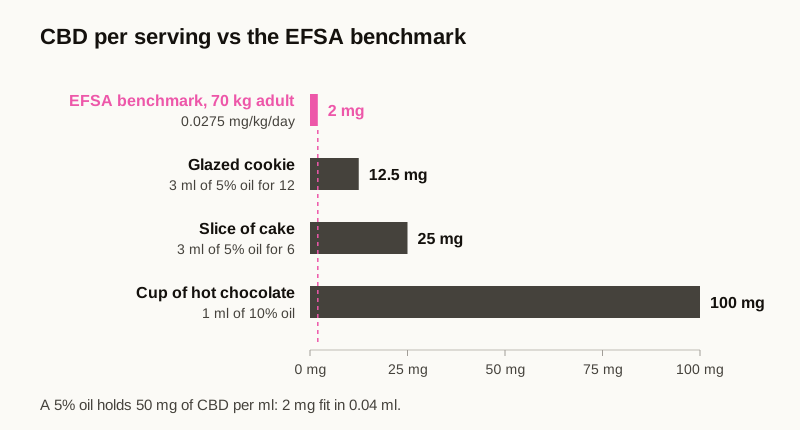
A 5% oil contains 50 mg of CBD per millilitre. Working out one serving is a simple division: amount of oil × concentration ÷ number of servings.
| Preparation | Oil added | Total CBD | CBD per serving |
|---|---|---|---|
| 12 iced cookies | 3 ml at 5% | 150 mg | 12.5 mg |
| Cake of 6 slices | 3 ml at 5% | 150 mg | 25 mg |
| One cup of hot chocolate | 1 ml at 10% | 100 mg | 100 mg |
In February 2026, EFSA set a provisional safe level of 0.0275 mg of CBD per kilogram of body weight per day, about 2 mg for a 70 kg adult. This benchmark applies to food supplements of CBD that is at least 98% pure, and it includes a safety margin for gaps in the data. With a 5% oil, it is reached with 0.04 ml, roughly one drop.
EFSA states that it cannot establish the safety of CBD for people under 25, for pregnant or breastfeeding women, or for people taking medication. Our article on the daily CBD dose according to EFSA details this benchmark, and the one on drug interactions explains the liver's role.
What French law says in 2026
A dish with CBD is a food, and CBD added to a food falls under the EU regulation on novel foods. No authorisation has been granted. On 20 May 2026, the French Ministry of Agriculture stated that foods with CBD among their ingredients are not authorised and must be withdrawn from the market, supplements and online sales included. It also reports a clear rise in poisoning reports since 2024.
Hemp seeds, their derivatives such as hemp seed oil, and leaves for infusion remain authorised as food, without any added cannabinoid extract. Selling or serving a homemade CBD cake to the public falls outside that framework. The detail is in our overview of CBD regulation in 2026.
A second file is under way. In March 2025, ANSES proposed classifying CBD as a presumed reproductive toxicant, category 1B, based on animal studies. The decision is taken at EU level; our article on this classification follows the procedure.
This article therefore describes how a molecule behaves in cooking. It does not invite you to swallow a product that food law does not authorise.
Behind the wheel: THC traces count
A so-called full-spectrum hemp oil can contain up to 0.30% Δ⁹-THC, and long cooking can form more from CBD. Driving after drug use is an offence whatever the dose: the Court of Cassation ruled so on 21 June 2023 in the case of a driver who had used CBD. Our guide to saliva testing gives the known detection windows.
Frequently asked questions
At what temperature does CBD break down?
There is no single threshold. Published measurements show a slow drop at 37 °C over a month and a loss of more than 80% after one hour at 220 °C for pure CBD. The stronger and longer the heat, the greater the loss.
Why not mix CBD with water?
Because it is fat-soluble and almost insoluble in water. In a water-based drink it stays in droplets and spreads poorly. A fat already in the recipe, butter, cream or oil, dissolves it.
Can cooking turn CBD into THC?
Yes, in part. In the 2022 study, CBD heated to 220 °C formed Δ⁹-THC, CBN and CBE. That is one more reason to avoid long cooking.
Can you buy a CBD cake or drink in France?
No. Since the French Ministry of Agriculture's statement of May 2026, foods with added CBD must be withdrawn from the market, as they have no novel food authorisation.
How much CBD is in a slice of homemade cake?
Divide the amount of oil by the number of servings, then multiply by the concentration. 3 ml of a 5% oil over 6 slices gives 25 mg per slice, more than twelve times EFSA's provisional benchmark for a 70 kg adult.
Written by the Phytogrammes team
Every article in this journal draws on primary sources (ANSM, EFSA, EUR-Lex, peer-reviewed publications) and on the lab's own practice: batch-by-batch HPLC analyses, measured cannabinoid profiles. Our approach.
Article published on . CBD is not a medicine.